
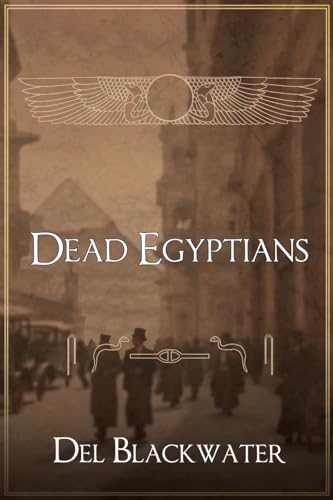
Ten questions for a writer: Del Blackwater and her novel Dead Egyptians (2024), by Abraham I. Fernández Pichel
Del Blackwater is a novelist and travel writer based in Wisconsin. Her life vacillates wildly between a quiet existence in the country and a feverish, risk-centric existence when on the road. Her travels have taken her to four continents, and she makes questionable decisions in all of them. While Egypt is inevitably the high-water mark of both her travels and her writing, she tries to spend time in other places as well. Del is published many times over as a board game and tarot deck designer, notably as the creator of Playlist Wars, a music game. When not keeping busy, she unwinds by taking care of a menagerie of critters and enjoying something she calls porch time.
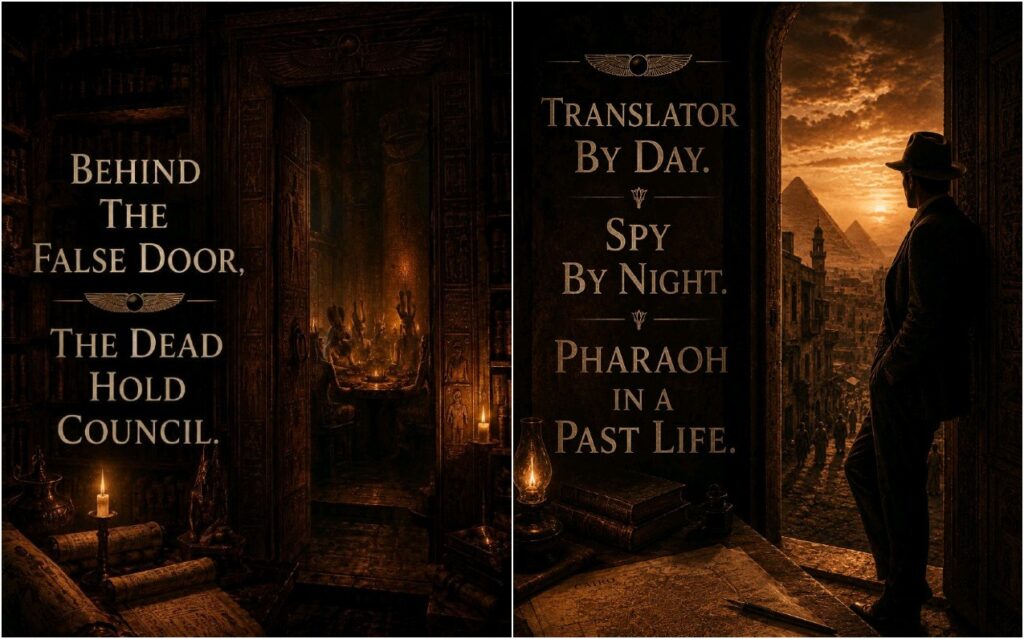
Summary of the book: In Egypt, all things are possible. So discovers Albion Stanley, a recent Cambridge graduate and brilliant linguist, newly arrived in Cairo in 1902. Albion sees the unseen, including ghosts. It is a less than comfortable reality, which he tends to with copious amounts of whiskey and numerous other vices. Also in Cairo is Aleister Crowley, the famed occultist. Aleister is a dangerous man, but not an unsympathetic one and never a dull one. Together, they discover the world of dead Egyptians, some of whom are older than the pyramids. Dead Egyptians have a lot to say. They are deeply unsatisfied with the state of modern Egypt, yet, for all their wisdom and power, they have limitations. As a Seer, Albion proves indispensable to both Crowley and the dead Egyptians. Dead Egyptians transports the reader into a glittering turn of the century Cairo, while also addressing the atrocities of colonialism. It is hedonistic, while also exploring the complex world of Ancient Egyptian religious thought. It is historically accurate down to the fabrics, while remaining fantastical at its core. (https://delblackwater.com/)
1.- Interviewer Egypopcult (IE): Could you tell us what motivated you – whether during your childhood, teenage years or as an adult – to start writing, and from when do you remember wanting to be a writer?
Del Blackwater (Del): I wrote from the time I could hold a pencil, and I was always interested in storytelling and films and so forth. My interest in Egyptology also started early, from the age of seven onwards. It was inevitable that these two great loves collide at some point, but I might have waited a lot longer, had not fate intervened. At age twenty-five, I developed Multiple Sclerosis and my health declined very rapidly. I decided not to wait, and started writing Dead Egyptians in my thirties when it became obvious that avocadoes and supplements were not going to turn the disease around. I poured everything I had into the book, just in case it was the only book I would see published. I’m thrilled to be wrong about that – book two (of seven) is coming soon and book three is well in hand.
2.- IE: In your career as a writer, what has been your most significant milestone as an author? (For example, winning an award, signing your first writing contract, having a manuscript accepted by a publisher…)?
Del: I’m sure I cried big crocodile tears when I first held the physical copy of the book, but for me, it was actually hugely significant when ISSE chose Dead Egyptians as their first book club selection. I managed to reach readers of queer fiction pretty painlessly (they’re a wonderfully rabid fan base), but it was much more difficult to reach the Egyptology community. I had more or less given up, so to see that a huge organization like yours knew about the book was incredibly validating.
3.- IE: Who were your literary influences during your formative years as a writer, and which genres were – and still are – your favourites?
Del: I remember being so bored in high school that I did a little experiment in the library. I looked at the spine of every single book until I found the oldest book in the collection. My logic was that the book that survived the library the longest must also be the best. It was The Picture of Dorian Gray by Oscar Wilde, and from that point on, I devoured anything he had to say. He hid his wisdom inside witticisms, and had the audacity to love other men (and put it to paper) back when it was a prison sentence. It cost him five years in the notorious Reading Gaol, and he never really recovered from his time in prison, but his light was too bright to be snuffed out, and he never apologized for his sexuality. Not even at the end. Later in life, I veered towards E.M. Forster and his more naturalistic (but still florid) dialogue.
I still love every variety of queer fiction. I’m also drawn to Africa, the Arab world, and the Slavic world – and when it comes to those places, I am equally happy in the realms of fiction and non-fiction. There’s room for everyone.
4.- IE: Your love of travel is evident in your work as a travel writer. With that in mind, which trip would you recommend above all others? And Egypt – from a personal point of view – what does it mean to you?
Del: I used to say “Everyone should go to Egypt,” and then I had a heartbreaking experience where someone very close to me went to Egypt, but completely ignored my advice and did everything that mortifies me – polluted the Nile river by taking a big cruise boat, touched things that were thousands of years old, even sat on surfaces in tombs, you name it. So now I say, “Everyone should go to Egypt, but not everyone deserves Egypt.”
Why does Egypt matter? Egyptians knew things, and they could do things we still can’t. I find it sickening that African history is not taught with the same fervor as Western history. If you go down the Egypt rabbit hole long enough and hard enough, and you do it with respect, your life will be enriched in immeasurable ways. Even magical ways. Especially magical ways. When I’m in Egypt, I feel the hand of destiny guiding me – if I find myself talking to a stranger, it’s not happenstance – it’s because Egypt wanted me to be in that place and time.
5.- IE: You have dedicated your novel Dead Egyptians to Egypt – both ancient and contemporary (though not the present day). What inspired you to write this book (academic reading, experiences from your travels, films, games, novels, etc.)?
Del: Egypt called me from the age of seven – you can blame Yul Brynner chewing the scenery as Ramses for that. I spent roughly the next twenty years reading the proper history books, learning Arabic, dabbling with hieroglyphics, studying artifacts in museums, doing all the things you’re supposed to do. My education still felt incomplete. I knew there was something out there, still waiting for me. Then, I discovered the works of Joan Grant, Dorothy Eady (Omm Sety) and Elizabeth Haich. These were all women who claimed to remember past lives in Ancient Egypt, and specifically remembered what was taught in the temples. Imagine my surprise when their work lined up with the archaeological record – and imagine my surprise when they all had similar things to say about what was really taught in the temples. I’m painfully aware that admitting this makes me the subject of ridicule, but Dead Egyptians could not exist without the work of those three women.
Naturally, my travels to Egypt also enriched the book in incalculable ways. I took five research trips to Egypt between 2017 and 2024, and was able to explore the Nile Valley, the western oases, and the Mediterranean coast. I knew exactly where Albion would go in each book, and I became obsessed with knowing the lay of the land so that the reader was in good hands. The cultural enrichment didn’t hurt, either. You don’t really know Egypt until you know Egyptians.
On a more personal level, I wanted to write about the experience of loving a ghost. I lost the love of my life when I was nineteen years old – he didn’t die, but we were separated by tragedy and circumstance. We found many ways to connect over the years, none of them physical. I suppose I wanted people to know that when the love is true, time and space can’t separate you. Love always finds a way.
6.- IE: How would you summarise Dead Egyptians in just a few words for our readers?
Del: In Egypt, death is never the end.
7.- IE: Imhotep, Seti, the Egyptian gods and the tombs. Reading your novel, I’ve noticed that some of the recurring themes of Egyptianising fiction feature in it, but it’s that and much more besides. What kind of ancient Egypt and what kind of early 20th-century Egypt did you set out to create for Dead Egyptians?
Del: I wanted Edwardian Egypt to be completely historically accurate. It wasn’t a difficult era of history to recreate – we have photographs, autobiographies, letters, records, you name it. It was all there.
Bringing Egypt’s Old Kingdom to life was a much more difficult task, but I approached it meticulously and truly poured decades of study into it. There’s much less information the further you go back in time, but that doesn’t make it easier – it means there’s more room for error. I gave it my all, though – I visited all the sites I write about, and studied all of the artifacts I could.
The book is historical fantasy, so of course there are magical and fantastical elements that don’t come strictly from history, but it might surprise you to learn how much of it comes from Ancient Egyptian religious thought. There’s an article on my website that breaks it down into much greater detail: Separating Fact From Fiction: The Mythology of Dead Egyptians. https://delblackwater.com/mythology-of-dead-egyptians/
8.- IE: One of the most striking aspects (in a good way, because of its originality, and in a bad way, because of the negative reaction it may provoke in some people) is the sexual orientation of some of your characters, particularly in the case of Imhotep. What can you tell us about that?
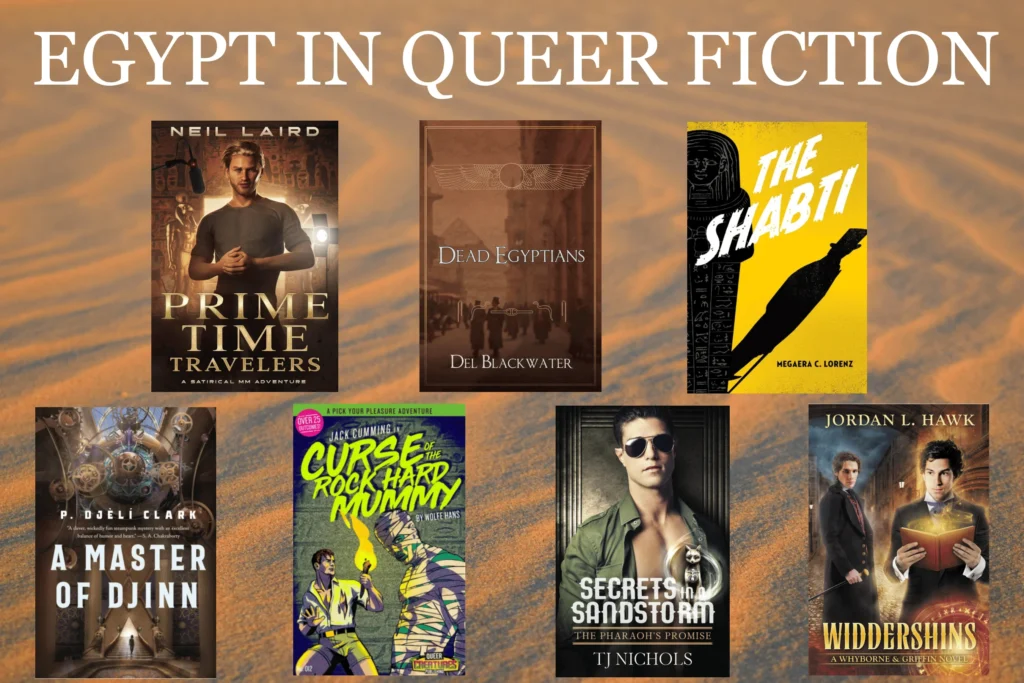
Del: Yes, the main relationship in the series is between two men. That’s really just my sexuality on the page – I’m non-binary, and consider myself male and female. I didn’t change my pronouns, because all of the pronouns work with me. I do prefer male-male couplings, given the choice. So Albion was always going to be a gay man. As far as Imhotep goes, we know very little about the real man. We have Saqqara, we have his legacy as passed down by Egyptians centuries later, and we have a statue of Pharaoh Djoser in which he stands on Imhotep’s titles. Vizier, High Priest, Physician, etc. I couldn’t imagine that Djoser standing on Imhotep’s titles was disrespect; it had to be Djoser saying, “I am nothing without the achievements of Imhotep.” And if that isn’t a romantic statement, I don’t know what is. Pharaohs were not exactly in the habit of honouring their viziers in that way.
The Ancient Egyptians did not have hang-ups about homosexuality – I’ve never found a court case condemning someone over a same-sex relationship. We also have lots of evidence that same-sex love was conducted completely openly – men buried together (Niankh-Khnum and Khnum-Hotep), love letters written between members of the same sex, love poetry – heck, even Horus and Seth got busy. Quite explicitly, I’ll add. So while my motivations were largely self-gratifying, I do think it’s important to remember that Ancient Egyptians would find modern homophobia baffling and short-sighted.
In terms of the reception of the book, it is a fact that homophobes everywhere took it upon themselves to leave me one-star reviews. One of the early reviews was, “You need to tell people your book is gay.” One star. There were also people that complained that there wasn’t enough sex, and for the record, there were more people demanding explicit sex than there were people condemning the sex. I’ll just end by saying that book two is significantly sexier than book one. Gotta give the people what they want.
9.- IE: In your book, you select two key moments in Egyptian history: its Pharaonic past and the period of foreign powers in the late 19th and early 20th centuries. As a bridge between the two, you highlight the enduring presence of certain figures across the centuries and their connection to the present through the ability to see the dead and reincarnate them in successive lives. In doing so, you draw on a fundamental theme of Egyptomania: the Egypt of mysteries and esotericism. As a paradigm of this temporal link, you choose Aleister Crowley. What attracted you to him, and what did you wish to convey about this contemporary Egypt?
Del: I had this great TIME-LIFE book called Mystic Places when I was a kid, and they included the story about Aleister Crowley and his honeymoon inside the Great Pyramid. Short version: Aleister took his wife into the King’s Chamber in 1903, and successfully performed an illumination spell. That story always stayed with me, and when I chose Edwardian Egypt as the era I would be writing about, I couldn’t resist including Aleister. His book Confessions of Aleister Crowley is one of the most fascinating things I’ve ever read. You don’t need to be a magical thinker to appreciate it – you can read it for the language, or to see what a forward-thinking man he really was. He wrote about things that weren’t really discussed in a serious way until the hippie era. Which is not to say that he’s my idol or that I’m a Thelemite – I’m not. I find him as repulsive as I do interesting. I just wanted to grapple with the full spectrum that was his personality. Was he the wickedest man alive? Or was he just a bohemian in a society that wasn’t ready for that sort of thing?
In the end, I went easy on him, and made him the vehicle for evil to work through, rather than the source of the evil. I imagined the source of the true evil corrupting him over time, and him falling victim to it. You can read more about Aleister Crowley in Egypt on my website: https://delblackwater.com/aleister-crowley-in-egypt/
To answer your second question, I ultimately chose Edwardian Egypt for the series (a planned seven-book series) so that I could tell the story of the Egyptian Revolution of 1919 without leaving anything out. It always made me upset that we stop talking about Egypt when Cleopatra loses to the Roman Empire – there’s two thousand years of fascinating history after that point in time, and so I tried to find a way to talk about the birth of modern Egypt while also talking about Ancient Egypt. Ghosts bridge the gap (long memories). So, too, people who remember their past lives.
10.- IE: Finally, what does the future hold for these and other characters from Dead Egyptians? (sequels, possible adaptations for other media…)?
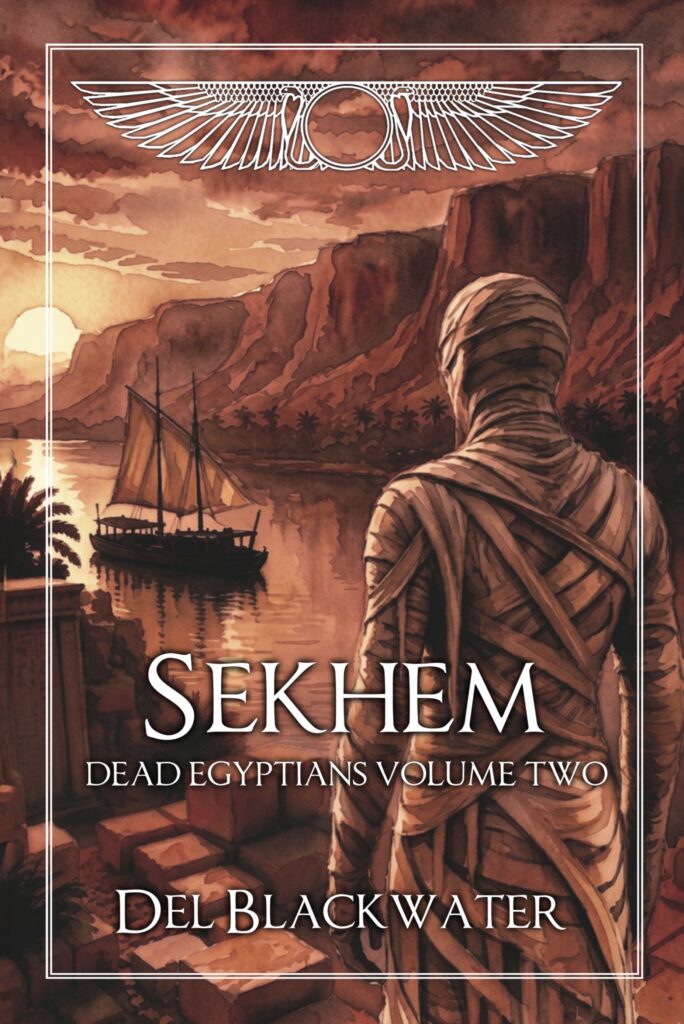
Del: Thank you for asking about Sekhem: Dead Egyptians Volume Two will be available wherever books are sold on November 23, 2026. It covers the Theodore Davis years (1905-1908). Albion finds himself in the Valley of the Kings, working closely with some of the biggest names in archaeology: Theodore Davis, Howard Carter, Arthur Weigall, John Garstang, and Edward Ayrton. His career begins to soar, but a workplace bully who knows too much and a mummy who knows way, way too much stand in his way.
Zooming out from Luxor, the roots of the Egyptian Revolution take hold when two incidents (The Saqqara Incident of 1905) and Denshawai (1906) convince Egyptians of every social strata that native rule has to be more than a casual discussion. Anything less would be undignified.
I still don’t have a film deal, but if anyone at HBO (Max) is reading, I’m extremely easy to get a hold of.
That’s all. To find out more about the book Dead Egyptians and its author, we recommend visiting her website (https://delblackwater.com/), where you’ll find various ways to purchase the book. Egypopcult, in collaboration with the International Society for the Study of Egyptomania (ISSE), had the pleasure of reading the book and speaking with its author during one of the ISSE Book Club sessions. It was a surprise and a unique opportunity to discuss the book with its author, which led to this interview that we have shared with you. Thank you so much, dear Del; we’ll be keeping a close eye on your work and we’re grateful for your approachability and, above all, for your book Dead Egyptians.
Author: Abraham I. Fernández Pichel
Citation:
Fernández Pichel, A.I. 2026, Ten questions for a writer: Del Blackwater and her novel Dead Egyptians, in A.I. Fernández Pichel (ed.) Egypopcult Project Website, Lisboa.
URL: https://egypopcultlisboa.pt/ten-questions-for-a-writer-del-blackwater-and-her-novel-dead-egyptians-by-abraham-i-fernandez-pichel/