Interview with ElTorres: a successful comic book author, by Abraham I. Fernández Pichel
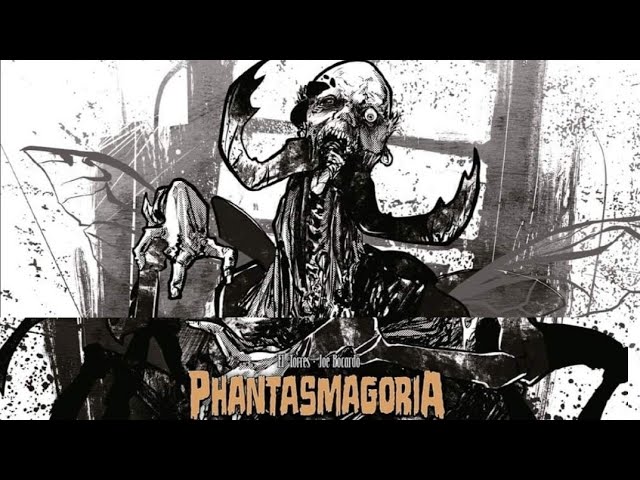
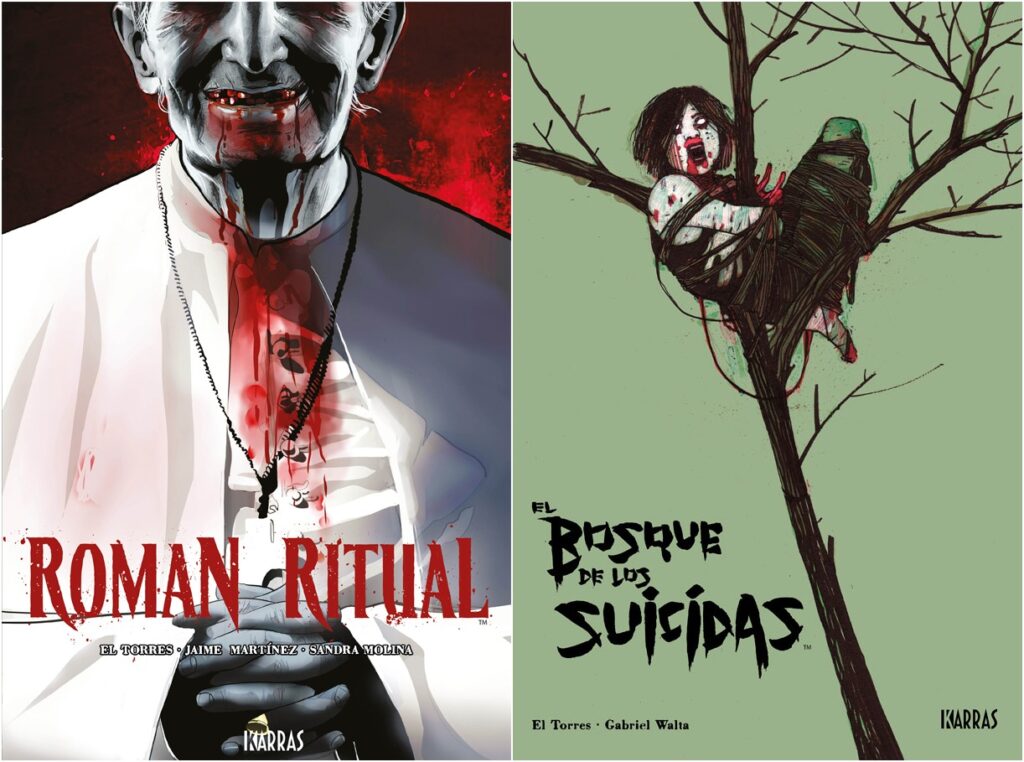
Juan ElTorres is an Andalusian comics editor and scriptwriter. His numerous works include Apocalypse Girl (2019), Roman Ritual (in two volumes, 2016 and 2023, awaiting the third volume that will close this horror trilogy) and The Suicide Forest (2011). As a follower of his work over the last decade, in some of his comic books I have noticed a particular taste of ElTorres for Egyptian narratives, something that crystallises in a relevant way in one of his major works, Phantasmagoria (2020). It was this that was the focus of our conversation on 9 May 2024, which we now publish on the Egypopcult website.
Summary of the comic book: In Victorian London, an occult lodge has released an entity, an Intruder from the Other Side, into our world. The creature possesses the brothers, forcing them to create a magical artefact: The Phantom Lens. But two wizards set out in search of it, two enemies locked in an eternal feud: Professor Hawke and Edwin Drodd. (Goodreads)
Abraham: Professor Francis Hawke’s character has an avatar that is a falcon, Horus, while his antagonist is Edwyn Drood, taken from the name of Charles Dickens’ last novel. What was the creative genesis for creating them both as a result of these and other influences?
ElTorres: Antagonistic allies, yin and yang, are common in fictional stories, and such characters, sometimes united and sometimes at odds with each other, work well. At first I thought of taking the origin of these characters, two ancient magicians, to ancient Babylon, but then we noticed the existence of two magicians who confronted Moses and were linked to Egypt: Janes and Jambres. They served as the inspiration for my characters. So I chose Egypt as the place where they both begin their training in magic, and this is the starting point that will later lead them both to “wander” through history until they reach the Victorian London that I recreate in the comic. So, I invented these two Egyptian apprentices and introduced alongside them a master-priest who could channel the innate power of Heka that they have. All of Hawke’s magic is based on Horus and Drood’s is based on Seth. They are enemies, but at the same time they can participate together in some episodes, as is the case with these gods in Egyptian mythology.
In the course of time, I also link the Egyptian wizards to Merlin, or incorporate influences from the film The Man Who Would Be King (John Houston, 1975). These milestones serve to provide the reader with the necessary information from their biographies but without telling it completely, so that each one fills in the gaps of what happened in their lives over time and in each epoch.
Abraham: Lodges, occultism, spiritism, mystery and magic are all fundamental elements of popular culture inspired by ancient Egypt. What works inspired you in this respect?
ElTorres: In this comic I wanted the Egypt recreated to be the one seen or re-imagined by Victorian authors. However, I didn’t have much time to do this kind of research, so I did some essential reading. I was interested, first of all, in the daily life of ancient Egypt. We are used to films in which the grandiose (great temples and pyramids, colourful sets) somehow obscure the everyday life of the characters. I preferred to show the reader this less spectacular side, for which the literary works of Christian Jacq were of great help. In addition, and although it is a fantasy recreation, Terry Pratchett’s novel Pyramids (1989) was relevant in the creative genesis of Phantasmagoria because it helped me to understand how to create an imagined Egypt integrated into a different world, in the case of the novel integrated into the Discworld. For the occult, mystical Victorian London, one of my recent readings was very useful: the work of Dan Simmons, Drood (2009), as well as the film Murder by Decree (Bob Clarck, 1979). These set up the present and the past of the comic book narrative.
The idea of spectres and monsters is very much influenced by the literature of H.P. Lovecraft, but I wanted it all to be in a Victorian context.
Going back to the Egyptian part, I have been able to visit Egypt and from my own observation I deduced the importance of the Nile, so it was the river that was the main focus of my interest and so I passed it on to the illustrator, Joe Bocardo, to recreate it visually as the axis of the story. The monumental seemed too typical to me. We’re a bit sick of seeing that every narrative set in Paris has to show the Eiffel Tower. I was much more interested in the small, the atmosphere of the country on the banks of the Nile, creating more of a sense of being there, shaping everyday scenes rather than grandiose cinematic scenes. All of this binds us more to the work as readers, even though often the comic book also resorts to these big scenes because, a priori, the budgetary constraints of creating cinematic sets don’t exist in the comic book. Even so, I wasn’t interested in the typical, but in the immersion in the environments, in the everyday life.
Abraham: On a visual level you also take multiple elements from previous popular culture, such as Hawke, who physically resembles the actor Peter Cushing, or in the passage where the wizard Merlin appears, in which he is clearly reminiscent of Merlin from John Boorman’s film Excalibur (1981). Did you also want to use this kind of inspiration in the ancient Egyptian part by drawing on previous products of Egyptianising popular culture?
ElTorres: In a comic everything is false, so what I recreate is a compendium of things I like. It’s like a cocktail shaker in which I put the ingredients I like, shake it up and something new comes out. When it came to capturing it visually, I transmitted a lot of information to the cartoon artist, Joe Bocardo, and I also had the help of my wife, who is a teacher of Art History and who was able to provide me with a lot of visual material, as for example, in the case of the Egyptian temple in the comic. I told them both that I was more interested in insinuating than showing, but that what we showed had to be recognisable. In this respect, it strikes me that in many films the temple in which the action sometimes takes place was already in ruins even at the time it was built. At some point the temple must have been new. Therefore, a comic had to recreate a world in which people live and not something unreal, a postcard. This is very much achieved in the video game Assassin’s Creed Origins (2017), where the temples and buildings are new and not ruins, and we see the life that goes on around them.
On a more pointed level, another element we hint at is that of the plagues of Egypt, which appears in multiple previous works, but we do it in a subtle way, so that the reader recognises the idea but that idea doesn’t obscure the main story of the comic and that, whether you know the reference or not, you can follow the plot of the comic. Recognising the biblical characters Janes and Jambres or Peter Cushing in Hawke adds another layer that you can enjoy.
Abraham: In the comic you introduce phrases in the Egyptian language, spoken by Hawke, while Drood speaks in Latin. Who advised you or how did you learn about the Egyptian language?
ElTorres: I was able to access various works on the Egyptian language and some quotations were taken from the Book of the Dead in editions easily accessible on the internet. The fact that Hawke speaks Egyptian shows him to be more closely linked to his origins in ancient Egypt, whereas Drood has been more clearly influenced by the Roman Empire in his life-history. Quotations from the latter were more readily available in a multitude of works on the history of ancient Rome. The correctness or otherwise of the ancient Egyptian quotations was of secondary importance to me. I told myself that this was a comic and that if it sounded Egyptian it was more than appropriate. What was difficult was to find phonetic transcriptions that are pronounceable for us, works whose edition allows us to reconstruct the vocalisation of these words. In my opinion, everything we recreate from the past, in this case the Egyptian past, does not have to be realistic, but it does have to sound realistic. Ancient Egypt is not even what Assassin’s Creed Origins shows, but by playing the game we realise that it is believable. This has nothing to do with accuracy.
Abraham: In the part set in ancient Egypt, an Egyptian temple appears, as previously mentioned. Did you base yourself on a specific temple to recreate its appearance? To me personally it looks a lot like Kom Ombo.
ElTorres: It is indeed the temple of Kom Ombo. Some images of this temple were used by the illustrator to visually create the temple, and I simply selected it because it combined the characteristics I needed for my story. In this regard, moreover, the city in which the temple is located in the comic is Nubet, which is the Egyptian name for the city of Kom Ombo. Therefore, I followed a specific model on which I based myself and that is this temple in Upper Egypt.
Abraham: And finally, do you think the reader can learn something about ancient Egypt by reading Phantasmagoria?
ElTorres: Personally, comics have always aroused my curiosity about many subjects, so it seems to me that in many cases the educational value of comics is enormous. In my works, I don’t tell the story of a character in an expository narrative way, that is, one character tells another the essential elements of the plot. This seems to me to be artificial, because the character who receives the information is inserted in that world and therefore knows everything that is being told. This discourse is aimed at the reader who does not know the story. I prefer to suggest the information, and let the reader be the one who is then interested in investigating these topics further. This is my learning strategy: to awaken the reader’s interest in what the comic doesn’t tell. So if you like Jerzy Kawalerowicz’s film Pharaoh (1966), and you are struck by a particular aspect of the Egypt it recreates, you can find out more about these questions yourself. With that film it happened to me in the case of the absence of light. I had seen films like Cleopatra (1963) by Joseph L. Mankiewicz, spectacular, colourful, and when I saw Pharaoh I saw how dark and sober the places were. This led me to research these environments. I found it equally striking in this film that the pharaoh’s inner self is reflected, not just the battles or the great feats. This led me to ask myself what the everyday life of the men who lived at this time in history was like, what they did and what they could think about. I think I have captured all of this in my comic.
Thank you very much once again, dear ElTorres, and we look forward to following your projects and to detecting other Egyptomaniacal issues in them.
We would like to thank the artist for his availability and kindness, as well as the intermediary who put us in contact with ElTorres, José Luis Muñoz “El Barbas”. I would like to thank them both for their help and their collaboration with the Egypopcult project, which has been developing for months with the aim of getting to know the creators of popular culture first hand.
Author: Abraham I. Fernández Pichel
Citation:
Fernández Pichel, A.I., 2026, Interview with ElTorres: a successful comic book author. In A.I. Fernández Pichel (ed.) Egypopcult Project Website, Lisboa.
URL: https://egypopcultlisboa.pt/interview-with-eltorres-a-successful-comic-book-author-by-abraham-i-fernandez-pichel/